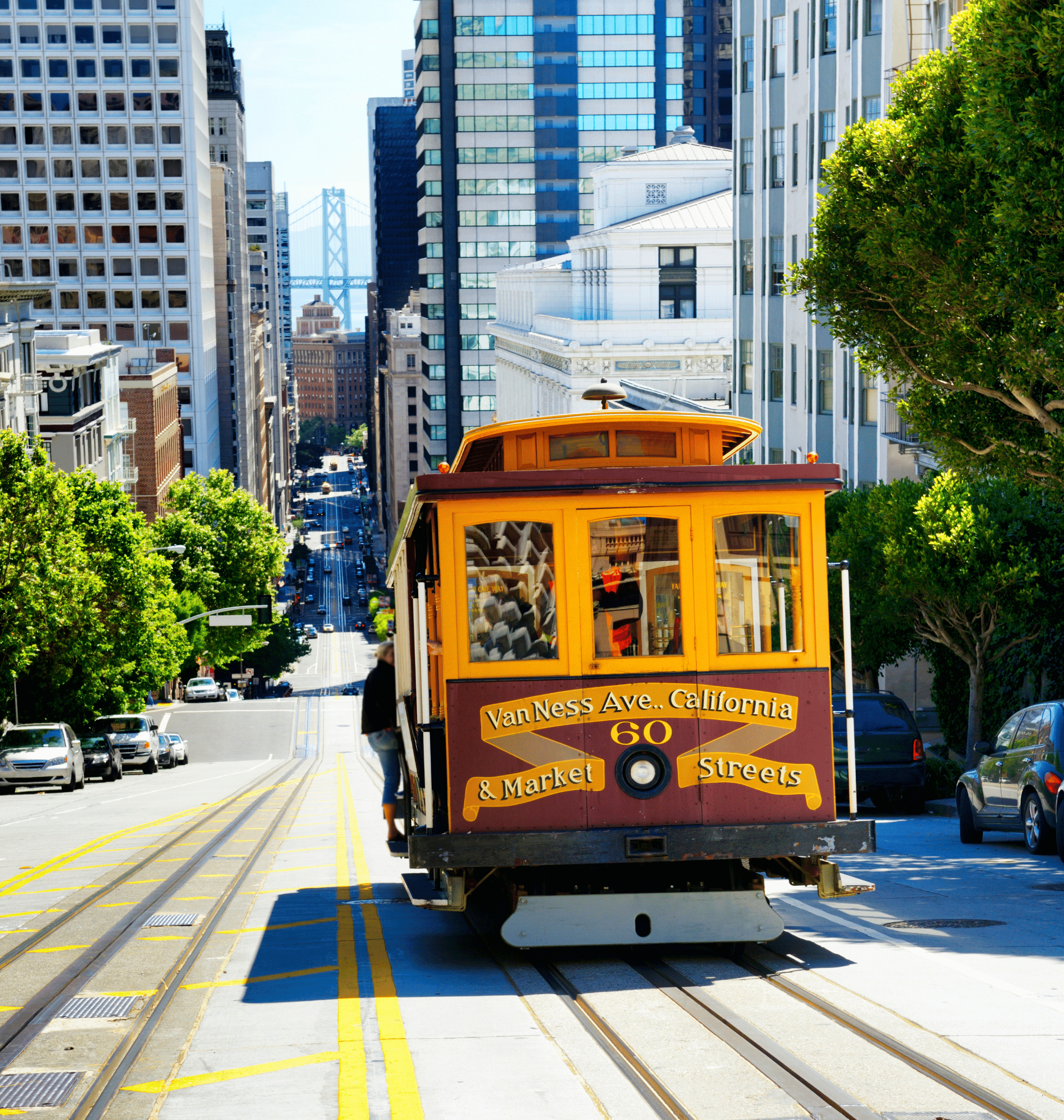
Charter a private jet from Boston or Providence to San Francisco and Silicon Valley. Departures from Hanscom (BED), Logan (BOS), Providence (PVD), and New Bedford (EWB) with arrivals at SJC, San Carlos (SQL), Hayward (HWD), and Moffett (NUQ). Pricing from $25,300 one-way. Ideal for executives, VC firms, and biotech travelers connecting the Route 128 corridor with Menlo Park and Sand Hill Road.
The Boston–San Francisco corridor is one of the most traveled private aviation routes in the country, connecting two of the United States’ most commercially active metros. Executives departing from Boston Logan International (BOS), Hanscom Field (BED), or T.F. Green in Providence (PVD) can reach San Jose International (SJC), San Francisco Bay Oakland International (HWD), or San Carlos Airport (SQL) in approximately five and a half to six hours nonstop — without the connecting-flight exposure, security theater, or schedule rigidity that defines commercial travel on this route. For passengers departing from the South Shore, Cape Ann, or the Rhode Island corridor, proximity airports like New Bedford Regional (EWB) and Providence (PVD) often eliminate the drive into Logan entirely.
Demand on this route is heavily driven by the finance, biotech, and venture capital communities that bridge both coasts. Boston’s Kendall Square and Route 128 life sciences cluster generate consistent eastbound and westbound traffic, as do the law firms, private equity groups, and family offices concentrated in Back Bay, Wellesley, Weston, and Westwood. On the California side, the Silicon Valley venture capital ecosystem — anchored in Menlo Park along Sand Hill Road — generates a disproportionate share of demand into SJC and the Bay Area reliever airports. For VC partners, portfolio founders, and the legal and advisory professionals who support them, avoiding SFO’s ground congestion and connecting through a closer general aviation terminal is not a convenience; it is a structural part of how the day is managed.
This page covers estimated charter pricing by aircraft category, arrival airport options on the San Francisco Peninsula and South Bay, FBO details, aircraft recommendations for the transcontinental distance, and practical booking guidance for this specific route.
| Aircraft Category | Estimated One-Way Price | Typical Passengers | Notes |
|---|---|---|---|
| Light Jet | $25,300 – $29,900 | 4–6 | Possible fuel stop depending on winds; best for small groups comfortable with a brief ground time |
| Midsize Jet | $27,600 – $32,200 | 6–8 | Most midsize jets handle this distance nonstop; strong value for small deal teams or family travel |
| Super-Midsize Jet | $28,750 – $36,800 | 8–10 | Preferred category for this route; full stand-up cabin, true coast-to-coast range, and productivity-focused interior |
| Large / Heavy Jet | $36,800 – $51,750 | 10–16 | Ideal for large delegations, board travel, or when in-flight meeting space is a priority |
Pricing reflects estimated one-way charter costs. Actual quotes depend on aircraft availability, fuel surcharges, repositioning fees, and demand. Contact us for a current market quote.
Passengers in Greater Boston and the Rhode Island corridor have several strong general aviation departure options, each with distinct advantages depending on origin city.
1. Boston Logan International (BOS) — Boston, MA
2. Hanscom Field (BED) — Bedford, MA
3. New Bedford Regional Airport (EWB) — New Bedford, MA
4. T.F. Green Providence Airport (PVD) — Warwick, RI
The Bay Area offers five viable private aviation arrival airports, each serving a different geographic pocket of the Peninsula, South Bay, and East Bay. Matching your destination community to the right airport can save 30 to 60 minutes on the ground.
1. San Jose International Airport (SJC) — San Jose, CA
2. Hayward Executive Airport (HWD) — Hayward, CA
3. San Carlos Airport (SQL) — San Carlos, CA
4. Moffett Federal Airfield (NUQ) — Mountain View, CA
At approximately 2,700 miles, the Boston–San Francisco route sits at the edge of midsize jet range and well within super-midsize and large jet capability. Aircraft selection significantly affects whether a fuel stop is required, cabin productivity, and overall cost-per-passenger efficiency.
The commercial routing from Boston to San Francisco involves a minimum 6-hour direct flight from Logan, with total door-to-door time typically running 9 to 11 hours when pre-flight security, terminal processing, and ground transportation to a Peninsula or South Bay destination are included. A private departure from Hanscom or Providence eliminates most of those friction points.
The net time saving is 3 to 4 hours each direction — a material consideration for any traveler for whom a same-day return is operationally meaningful.
Q: How far in advance should I book a Boston–San Francisco charter?
For standard travel outside peak windows, 48 to 72 hours is typically sufficient to secure a super-midsize aircraft at market pricing. During Q4, the January healthcare conference, and spring tech conference season, 7 to 14 days is advisable, particularly for heavy jets and for specific aircraft preferences.
Q: Is pricing quoted one-way or round-trip for this route?
Prices on this page are one-way estimates. Round-trip pricing is available when both legs are confirmed together and can often deliver a 10 to 15 percent savings over two separate one-way bookings, particularly when the aircraft can be repositioned efficiently or the turnaround is same-day or overnight.
Q: Can I depart from Providence or New Bedford and still access the same aircraft fleet?
Yes. Most charter operators serving the Northeast can position aircraft to PVD or EWB from Hanscom or Logan with minimal repositioning fees, particularly for midsize and super-midsize aircraft. The cost difference is generally modest and is often outweighed by the time saved avoiding a Logan departure for passengers based south of Boston or in Rhode Island.
Q: Which Bay Area airport is closest to Sand Hill Road and the Menlo Park VC community?
San Carlos (SQL) is the closest general aviation airport to Sand Hill Road at roughly 3 miles, but its runway limitations restrict it to lighter aircraft. SJC is the most practical option for any aircraft category: 20 minutes door-to-door to most Menlo Park, Palo Alto, and Atherton addresses, with full FBO services and no runway restrictions. For larger groups or heavy aircraft, SJC is the default choice for VC-corridor arrivals.
Q: Do charter prices vary by time of year on this route?
Yes, meaningfully. The Boston–San Francisco corridor sees demand spikes tied to the venture and biotech conference calendar, Q4 portfolio activity, and the summer leisure travel overlap. Pricing in peak windows can run 15 to 25 percent above base estimates. Off-peak travel — mid-January through February and mid-summer for business travelers — tends to offer the best availability and pricing flexibility.

When our company plane has other commitments or is down for maintenance, ECS is the only company I ever work with for our supplemental lift.
Jen Ashcroft Flight Operations
We previously used a jet-card membership with another company, but when ECS helped us complete a flight when our membership couldn’t it was easy deciding who we would be going to for all of our future flights. Thanks for saving the big day, and our road show.
Mary Jacobs SVP, Sales
Executive Charter Services helps me look good. My boss knows she’ll get a great private jet experience each time, and I know that ECS will make arranging and planning the flight stress-free and easy despite our never-ending, and frequent last-minute changes!
Mark D. Personal Assistant to A-List Celebrity
We have a different need almost every time we call. We’ve used smaller jets for the sales team, and longer-range options for our chairman and board. ECS makes all the arrangements and ensures everything goes smoothly, every time.
Nicole Angleton Senior Executive Assistant to the Chairman
When everything has to be perfect ECS makes it happen.
Lori Adams Personal Assistant
The best in the business!
Kelly Jackson Assistant to President
Knowledgeable, professional, personal, and discreet – that’s why we keep coming back.
John Markley Corporate Travel Advisor
ECS makes it possible to accomplish the impossible.
Louis Seargant Talent Manager
ECS makes it easy for me to schedule a jet for my boss. One call, and I know that Kevin and his team are working hard to find the best jet at the best price.
Susan Ferrier Executive Assistant to CEO
Kevin has eliminated the need for me to navigate the myriad of companies in the jet charter space. I go directly to Kevin now as he is highly responsive, has impeccable attention to detail, understands the client base which he serves and is always competitive on pricing.
Luciel L. Executive Assistant at Benchmark